Hidden Heroes of Crisis: Why OEM Physicians are the Ultimate Disaster Responders
When a train derails, a chemical plant leaks, or a wildfire blankets a city in toxic smoke, who coordinates the medical aftermath?
Most people think immediately of first responders and ER doctors. While they are vital for the first golden hour of trauma care, a massive piece of the puzzle happens behind the scenes.
Enter Occupational and Environmental Medicine (OEM) specialists.
OEM physicians possess a hyper-specific, multi-disciplinary skillset that bridges the gap between emergency response, toxicology, and long-term community survival. Here is why these specialists are essential partners to public health agencies during and long after a mass casualty event.
The Ultimate Toolkit for Disaster and Crowd Medicine
OEM specialists don’t just treat injuries; they calculate risks across entire populations. Their standard workplace training translates seamlessly to large-scale community disasters like chemical spills, floods, or structural failures.
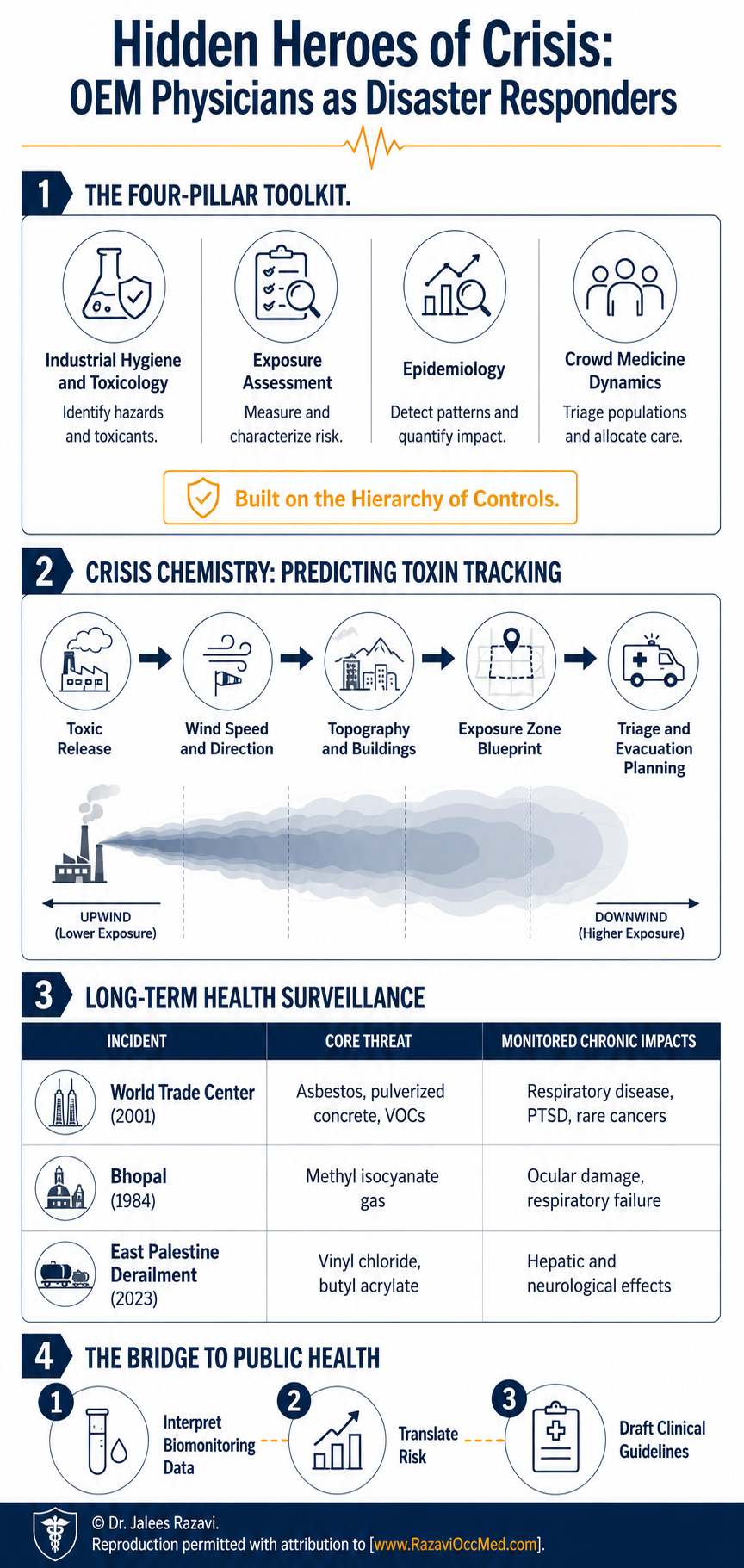
When managing an acute crisis, an OEM physician relies on four core pillars:
Occupational/Industrial Hygiene & Toxicology: Understanding exactly how dangerous chemicals interact with the human body.
Exposure Assessment: Evaluating how much of a toxin a population was actually subjected to.
Epidemiology: Tracking disease and symptom patterns across large groups of people.
Crowd Medicine Dynamics: Applying hazard recognition and surge capacity principles to manage health risks at massive public gatherings.
The OEM Advantage: Because they routinely protect high-consequence workforces (like chemical plant workers, miners, and firefighters), OEM doctors are already experts at implementing the Hierarchy of Controls a systematic framework used to eliminate or minimize exposure to hazards.
Crisis Chemistry: Predicting Toxin Tracking in Real Time
During an airborne chemical release or a fast-moving wildfire, mapping the danger zone is a matter of life and death. This is where the principles of occupational hygiene pivot to save communities.
OEM physicians understand exactly how environmental variables alter human risk:
[Toxic Release] ➔ [Wind Speed & Direction] ➔ [Topography/Buildings] ➔ [Exposure Zone Blueprint]
By calculating how wind speed, thermal inversions, and local geography disperse airborne contaminants, they help authorities establish highly accurate upwind versus downwind exposure zones. This data dictates where to place triage tents, how to map safe evacuation corridors, and how to safely deploy emergency personnel without turning the rescuers into patients.
Beyond the Initial Blast: The Crucial Need for Long-Term Health Surveillance
The chaotic frontline response is only the first phase of a disaster. The true toll of an environmental emergency often unfolds over months, years, or even decades. Many toxic exposures cause latent diseases, illnesses like cancers, pulmonary fibrosis, or chronic autoimmune conditions that don't show symptoms for a long time.
OEM physicians are uniquely trained to build the clinical frameworks required for long-term health monitoring. This sustained oversight is vital for tracking populations exposed to historic emergencies:
Landmark Incident | Core Environmental Threat | Chronic Health Impacts Monitored |
World Trade Center Attacks | Asbestos, pulverized concrete, heavy metals, VOCs | Chronic respiratory disease, PTSD, rare cancers |
Bhopal Disaster | Methyl isocyanate gas | Chronic ocular damage, severe respiratory failure |
East Palestine Derailment | Vinyl chloride, butyl acrylate, combustion byproducts | Hepatic toxicity risks, persistent neurological symptoms |
The Bridge to Public Health
When the smoke clears, an OEM physician’s job is just getting started. They serve as the analytical engine for public health agencies by:
1. Interpreting Biomonitoring Data: Analyzing blood, urine, or tissue samples to calculate exact internal chemical doses in affected citizens.
2. Translating Risk: Communicating terrifying, complex toxicological data into clear, actionable advice for a frightened public.
3. Drafting Clinical Guidelines: Authoring the exact medical testing and treatment protocols that local family doctors will use to care for exposed patients for the rest of their lives.
Disaster response requires an army of specialists. But when it comes to predicting where a chemical threat will go, managing the chaos of a crowd, and protecting a community from invisible, long-term health threats, OEM physicians are the ultimate commanders.
This infographic, developed by Dr. Jalees Razavi, illustrates the trajectory of an OEM-led response. It maps how immediate workplace principles like industrial hygiene and toxic dispersion modeling (calculating upwind versus downwind exposure zones) directly pivot into multi-decade longitudinal health surveillance programs for disasters like the East Palestine derailment and the World Trade Center attacks


Comments