Global Occupational Health: Regulation & Practice Differences

Occupational Health Is One Integrated Discipline
Occupational Health — inclusive of Occupational Medicine, Occupational Health Nursing, and Occupational Hygiene — is a single, integrated scientific and professional discipline. It is grounded in exposure science, epidemiology, clinical medicine, risk assessment, prevention strategy, and regulatory compliance.
However, while the scientific foundation is shared globally, the systems within which Occupational Health professionals operate differ significantly across jurisdictions.
Global Occupational Health practice is shaped not only by science, but by governance structures, enforcement capacity, compensation models, labor markets, and economic development patterns.
Understanding these differences is essential for credible international dialogue.
Regulatory Frameworks in Occupational Medicine Differ Worldwide
Occupational Medicine regulation varies substantially between countries.
For example:
Workers’ compensation systems in Canada operate within structured provincial regulatory frameworks.
Informal labor sectors in parts of South Asia may function with limited enforcement oversight.
Occupational safety enforcement capacity in regions of Africa differs from Central and Eastern Europe.
MENA jurisdictions often operate under distinct labor law models influenced by migrant workforce dynamics.
Australia and parts of Latin America may have different return-to-work and impairment assessment standards.
These regulatory differences directly affect:
Exposure limit enforcement
Fitness-for-work assessments
Disability evaluation
Causation analysis
Surveillance and reporting requirements
When professionals speak about “best practice in Occupational Health,” the regulatory context must be acknowledged.
Best practice is never context-free.
Occupational Hygiene Standards and Exposure Profiles Are Not Uniform
Occupational Hygiene is inherently tied to local industry and environmental conditions.
Silica exposure in mining sectors, pesticide exposure in agricultural economies, diesel exhaust in transport corridors, and heat stress in arid regions are not evenly distributed across the globe.
Exposure assessment methods, permissible exposure limits (PELs), and biological monitoring standards vary across:
North America
Southeast Asia
Europe
MENA
Sub-Saharan Africa
Surveillance capacity and laboratory access also influence how effectively hazards are monitored.
Without understanding regional exposure patterns, it is impossible to create meaningful global prevention strategies.
Compensation Models and Workforce Pressures Shape Practice
Occupational Health Nursing systems, physician staffing ratios, and specialist access vary widely.
In some jurisdictions:
There is structured access to board-certified Occupational Physicians.
Compensation adjudication systems are highly developed.
Return-to-work pathways are formally regulated.
In others:
Informal labor sectors dominate.
Migrant worker protections may differ.
Access to occupational hygienists or epidemiologists may be limited.
These structural differences influence how injuries are managed, how prevention is implemented, and how data is collected.
Cross-jurisdictional comparison strengthens policy design.
Why Geographic Diversity Strengthens Occupational Health Science
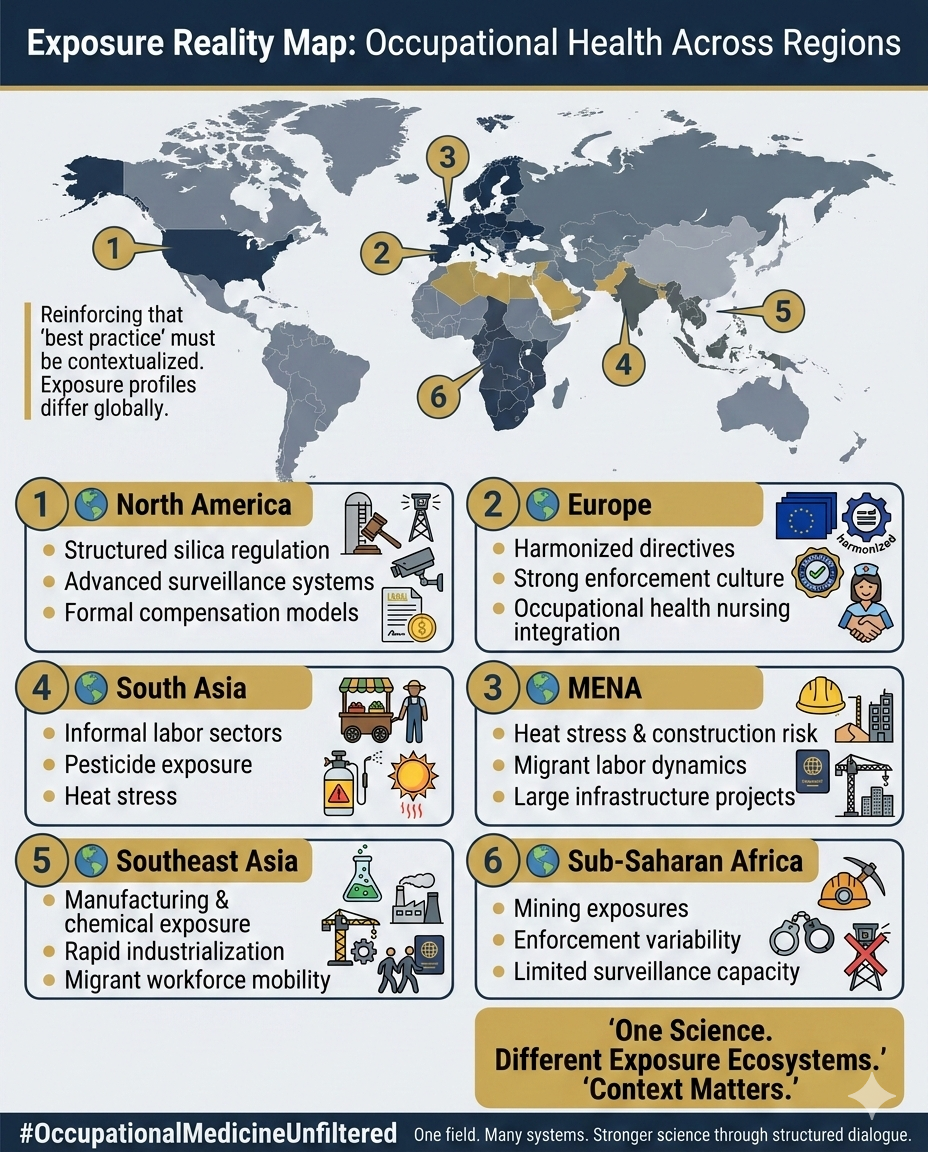
Geographic diversity in Occupational Health is not symbolic inclusion. It is methodological rigor.
When occupational hygienists, nurses, physicians, regulators, and epidemiologists from multiple regions engage in structured dialogue, they:
Test regulatory assumptions
Identify enforcement gaps
Compare exposure assessment methodologies
Refine causation analysis approaches
Improve global prevention strategies
Cross-jurisdictional literacy reduces regulatory bias and strengthens evidence-based practice.
Global Occupational Health governance benefits from comparative systems awareness.
Building Cross-Jurisdictional Occupational Health Dialogue
If Occupational Health is to evolve as a mature global discipline, it requires:
Structured international dialogue
Multidisciplinary collaboration
Transparency in regulatory differences
Recognition of informal labor realities
Evidence-based policy adaptation
A credible global Occupational Health framework must account for real-world regulatory diversity.
The discipline is unified by science — but shaped by systems.
Conclusion: One Field, Multiple Realities
Occupational Health is one field.
But it operates within multiple regulatory, economic, and workforce ecosystems.
Stronger science requires broader systems awareness. Better policy requires cross-jurisdictional literacy. Credible prevention requires integrated professional voices.
Global Occupational Health practice does not succeed by assuming uniformity. It succeeds by recognizing complexity — and engaging with it deliberately.


Comments