Balancing Compliance and Legacy in Occupational Health Systems
- drjaleesrazavi
- Dec 29, 2025
- 2 min read
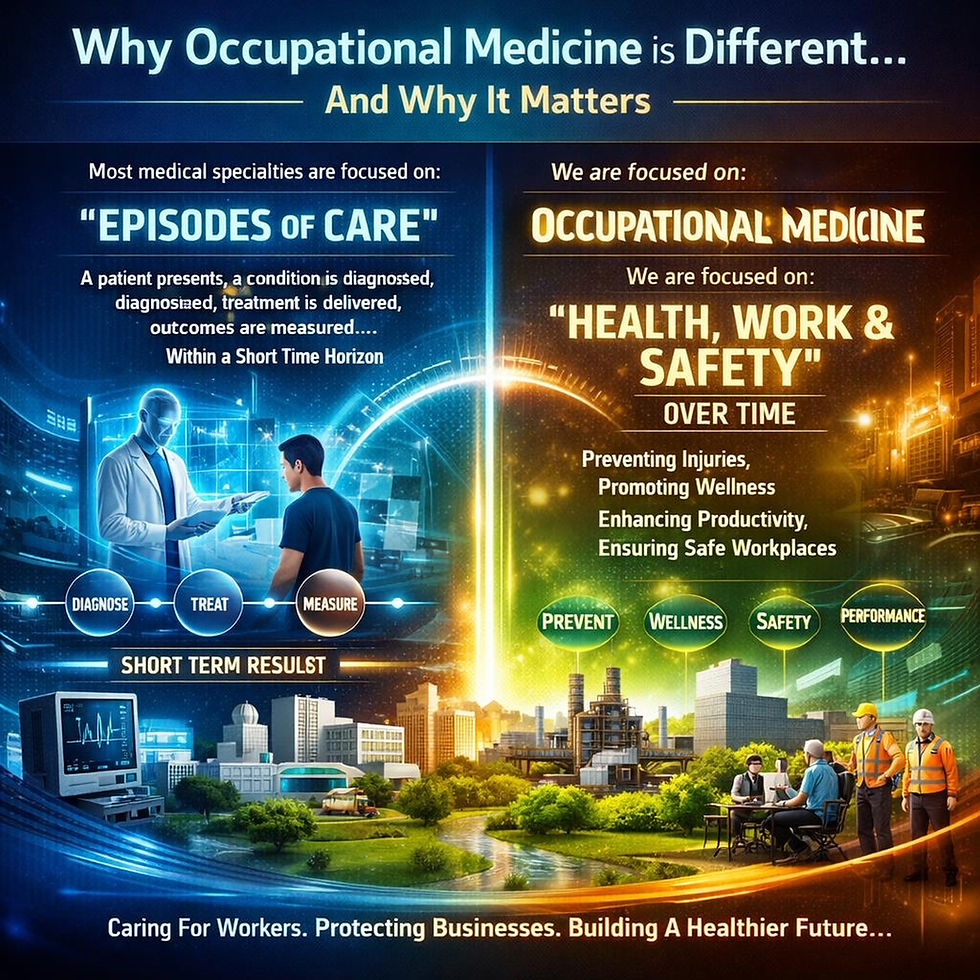
By now, the central idea should be clear. Occupational Medicine is not a service of moments. It is a system that shapes lives, careers, and outcomes across decades. The real question is no longer whether this is true, but whether our occupational health systems are designed to reflect it.
Most contemporary frameworks are built around compliance. They ask predictable questions:
Are the forms completed?
Are exposure limits technically met?
Are incidents defensible on paper?
These questions matter. They protect institutions, satisfy regulators, and reduce immediate liability. But they are fundamentally incomplete.
A legacy-based occupational health system asks different, more consequential questions:
What risks are we knowingly passing forward?
Which hazards are only being managed after harm has already occurred?
What institutional knowledge will vanish when today’s experts retire or move on?
The distinction between compliance and legacy is not primarily about funding. It is about intent, structure, governance, and where Occupational Medicine is positioned within decision-making systems.
This body of work reflects thinking shaped quietly over many years, much of it informed by the design and maturation of the Saudi Aramco Firefighters Health and Wellness Program. That program demonstrated what generational Occupational Medicine looks like when it is allowed to function as intended. It was not built on episodic assessments, short-term optics, or reactive interventions. It was built on continuity, integration, professional independence, and long-term stewardship—and its value has been proven over time.
It was through that experience that my guiding principle emerged: Have a healthy career. Not a healthy year.Not a successful incident-free quarter.A healthy career.
This is not an abstract ideal or academic theory. It is a tested and successful approach when Occupational Medicine is positioned upstream, embedded across disciplines, and evaluated by what it prevents—not merely by what it documents.
The Generations Physician is not an idealist. They are a realist who understands that prevention delayed is prevention denied—and that the true cost of short-term thinking is often paid by those who had no voice in the original decision.
Governments, regulators, employers, and professional bodies now face a simple but uncomfortable choice:
Will Occupational Medicine be designed to protect quarterly metrics…or to safeguard people we will never meet?
Because legacy, in Occupational Medicine, is not defined by mission statements or policies. It is defined by outcomes.
And ultimately, it is defined by what we leave behind.

.
Comments